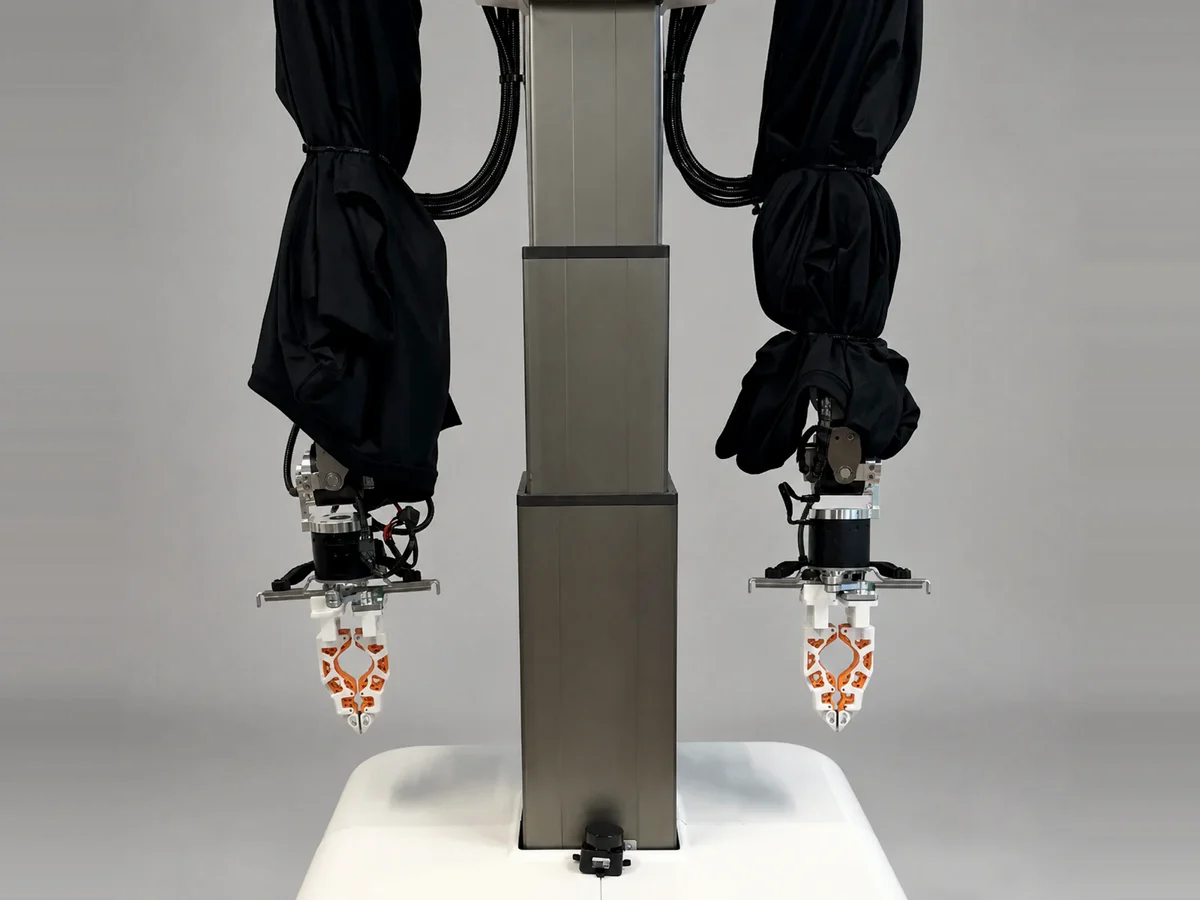
01 · Manipulation
Arms + vertical lift
A shared bimanual workspace across working heights.
Both arms use one action space while the lift repositions that workspace vertically, including while the base is moving.
HALE 1.0
A 22-degree-of-freedom bimanual mobile robot on actuators we design ourselves, run by a model pretrained on 150,000 hours of video.
Hardware
Four systems form one body. OS3 owns the body architecture, custom actuators, control stack, model and training loop.
01 · Manipulation
A shared bimanual workspace across working heights.
Both arms use one action space while the lift repositions that workspace vertically, including while the base is moving.
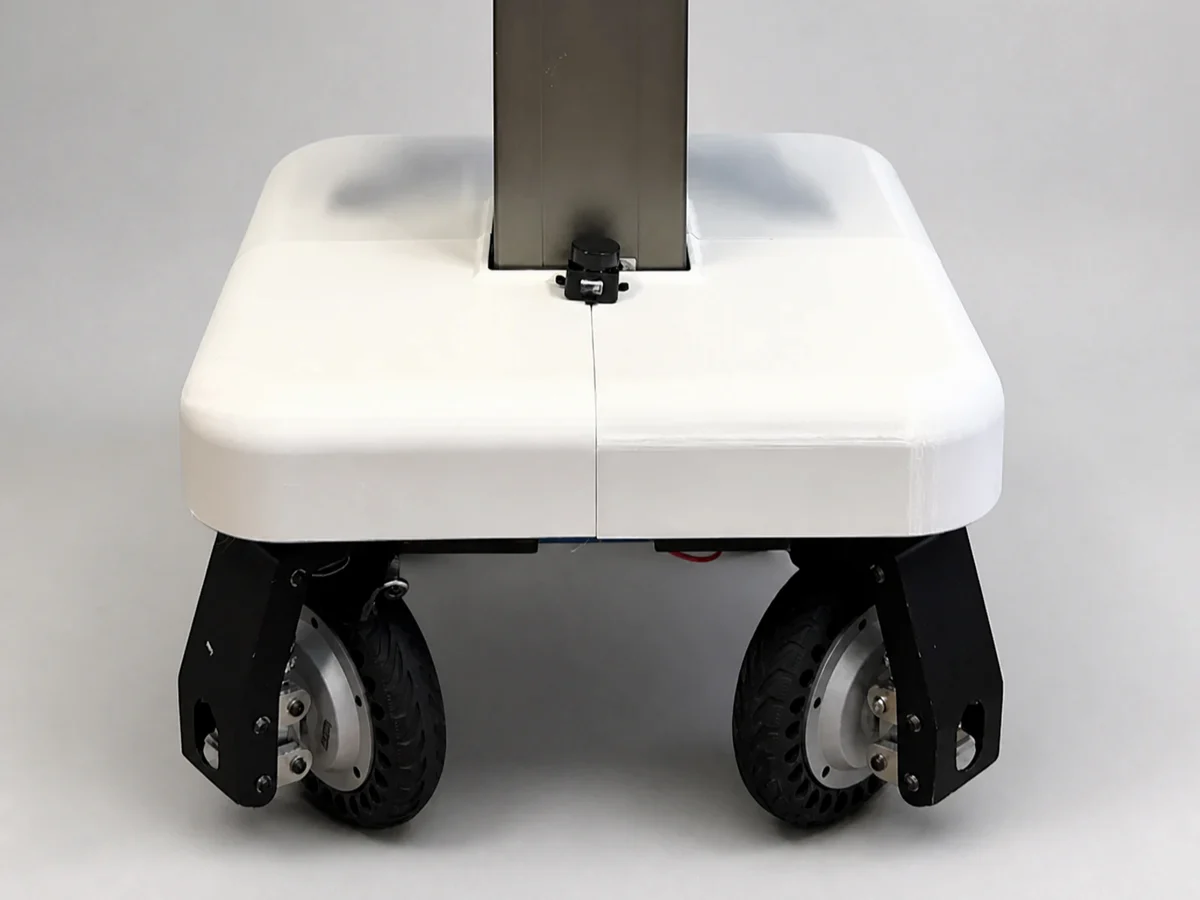
02 · Mobility
Lateral positioning in tight rooms.
Holonomic drive moves the whole workspace sideways without turning the robot in place.
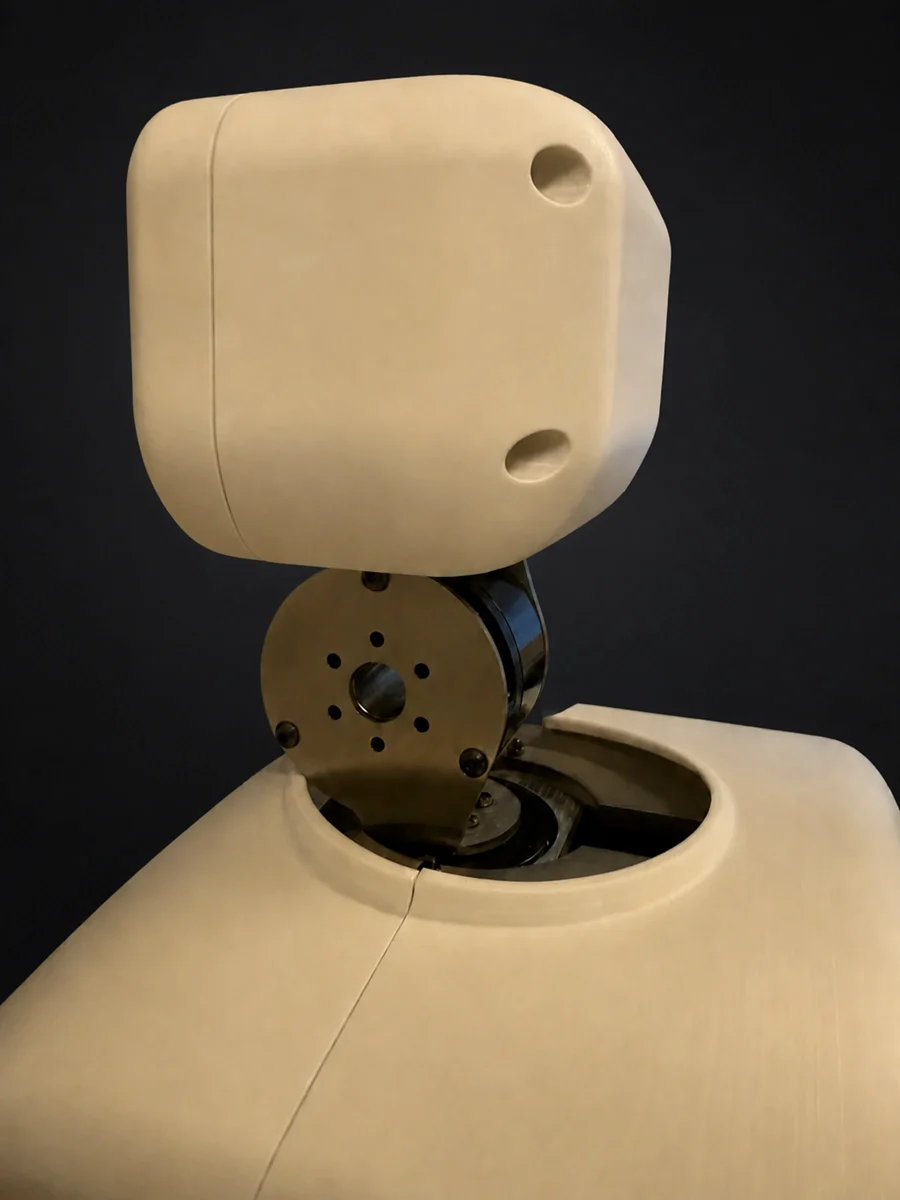
03 · Perception
Independent gaze stays on the active workspace.
The head keeps the scene cameras aimed while the arms, lift and base continue moving.
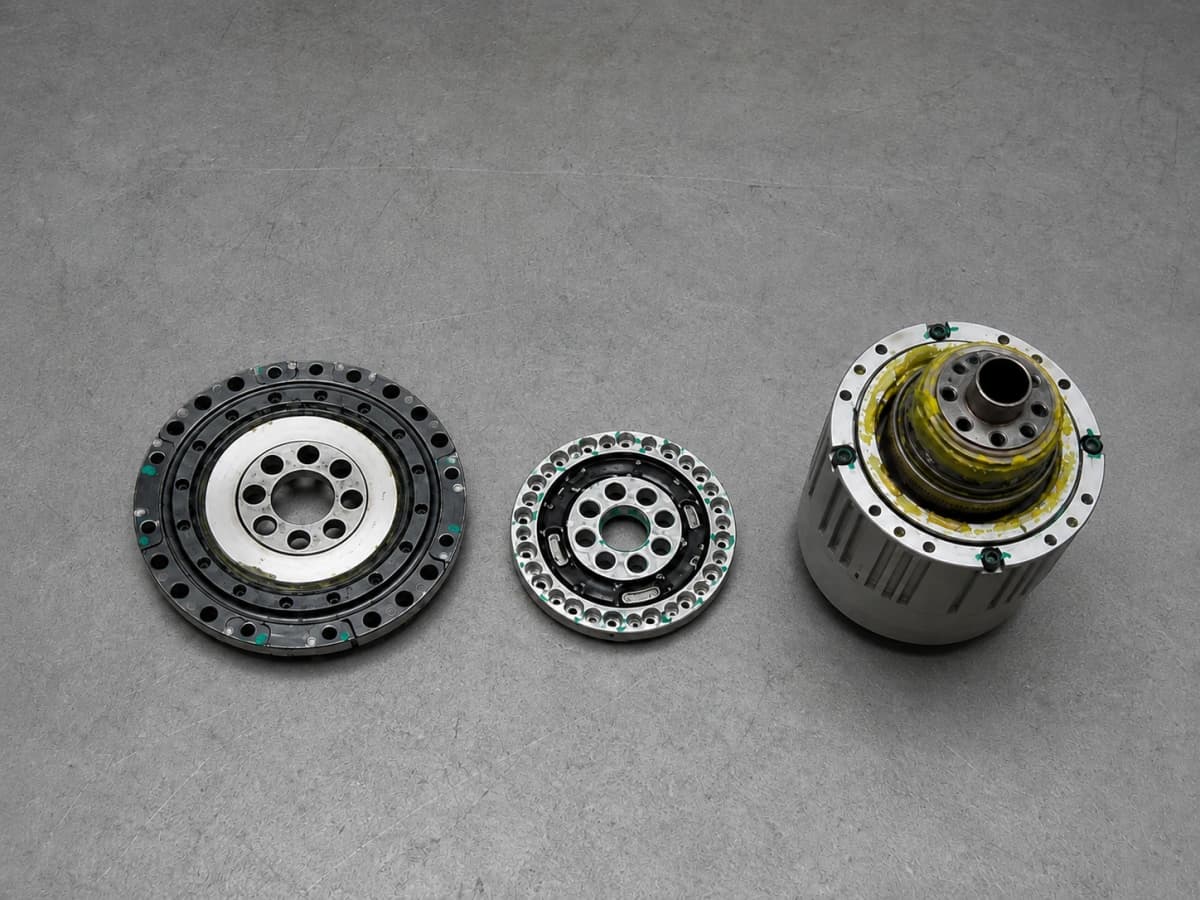
04 · Actuation
The mechanical layer OS3 builds in house.
One actuator architecture runs across the upper body and exposes full-state commands to the shared control stack.
9 lb nominal, 15 lb peak, per arm.
Telescoping torso, floor to top shelf.
Omnidirectional. Fits standard doorways.
Quasi-direct-drive, backdrivable, torque-controlled.
Head cameras standard. Chest and wrist depth on developer units.
Front LiDAR standard. Rear LiDAR on developer units.
Charges from a standard outlet.
Cloud planner. Local manipulation policy.
Designed and built in San Francisco, California.
The model
Long-horizon reasoning and whole-body action run at different timescales, then meet in one control path.
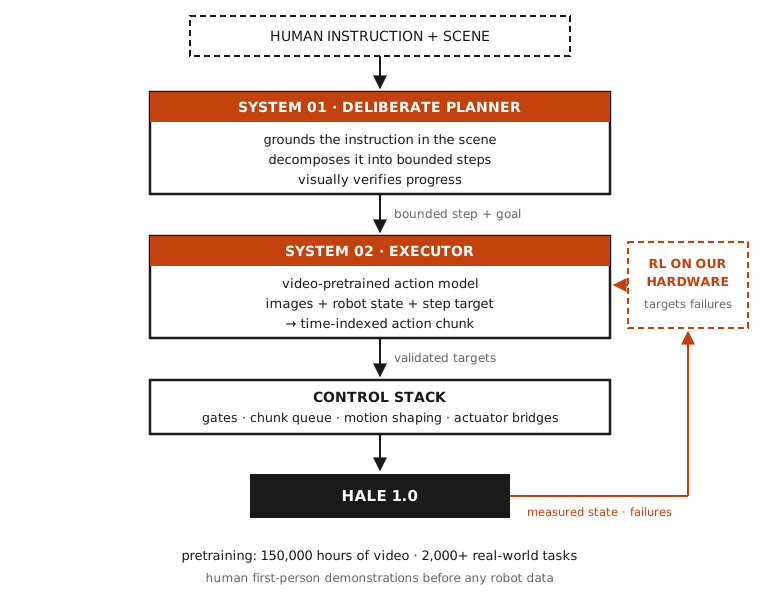
System 01
Maintains task context across long workflows. It stays outside the servo loop, so planning latency does not set actuator timing.
System 02
Uses one whole-body policy with a contact-rich manipulation mode. Switching modes does not hand the task to a separate subsystem.
Control stack
Owns the timing boundary between policy output and hardware, keeping streamed motion smooth and compliant.
Read the control-stack articleTeleoperation and data
Demonstrations come from people, with or without a robot in the room. A new task starts from two to four hours of them.
Rig 01
Drive both arms and the base from a headset, with the robot's own cameras as your eyes.
Rig 02
A printable handheld controller that mirrors the arm kinematics and can be reproduced wherever demonstrations are collected.
Rig 03
Wearable arms that track the operator's joints directly for high-fidelity bimanual demonstrations.
Rig 04
A gripper with cameras and no robot attached. Collect first-person demonstrations anywhere the work happens.
The training loop
Production robots fail. The question is whether they finish anyway, and whether the next one fails less. Our loop runs on our own hardware, with failures from real floors.
The robot attempts the workflow and retries recoverable misses on the spot.
When retry is not enough, a remote operator completes the step and captures the correction.
Reinforcement learning on OS3 hardware targets those failures for future policy updates.
Safety
Built to work next to people, in rooms that were never designed for robots.
Go deeper
How the physics layer makes the metal keep up with the model: identified dynamics, feedforward-first impedance control, trajectory shaping, and the measurements to prove it.
Partner with OS3
Start from the robot, model and training loop we already operate.